Geometry Dash Meltdown
- 4.6
- Rating
- 100.00M
- Installs
- Free
- Price
 Analysis by App-foxy
Geometry Dash Meltdown is the kind of arcade game I recommend with one important warning: it is wonderfully easy to understand and surprisingly difficult to master. I installed it expecting quick tap-based action, and that is exactly what I found, but the real appeal is how tightly movement, music, visual timing, and failure are connected. A short attempt can feel effortless until one obstacle breaks the rhythm, sending me back to try the same section with slightly better timing.
That simple loop remains the game’s strongest argument. You guide a moving character through hazards by tapping at the right moments, jumping, flying, and reacting to changes in the course. There is no complicated control scheme to learn, yet the levels demand concentration. In my experience, the best sessions are not necessarily long ones. A few focused attempts during a break can be more satisfying than an extended play session because every mistake gives me a clear clue about what to adjust.
Why the timing feels so satisfying
The game belongs to the arcade category, but it also feels like a rhythm challenge because the action is built around musical movement. I quickly stopped thinking only about the next obstacle and began listening for the timing of jumps and transitions. That does not make the levels automatic, of course. Sound can guide me, but I still need to watch the path, recognize visual cues, and react when the course changes pace.
You May Also Like

 Blood Strike: 2.5 Anniversary
Blood Strike’s Loadouts Turn Every Drop Into a Tactical Gamble
A close look at Blood Strike’s custom loadouts: how fast access to signature weapons reshapes its battle royale rhythm, rewards preparation, and narrows the gap between fights.

 Pandora - Music & Podcasts
Pandora’s Music Is Easy to Start, but Harder to Recover
Pandora’s strength is its low-effort path from a seed to a station. Its weak spot is how much confidence it asks you to place in connection, setup, and quiet recovery.

 8 Ball Pool
 Is Built on Rivalries, Rematches, and Routine
A close look at the rivalries, rematches, shared routines, and unanswered safety questions that turn a quick pool match into a persistent mobile community.

 Samsung Music
’s Quiet Strength Is Playing What You Already Own
Its reach comes less from spectacle than from dependable access to a personal library. That simplicity is both the app’s strongest retention engine and its ceiling.

 AccuWeather: Weather Radar
AccuWeather Review: A Quick, Clear Forecast for Everyday Decisions
For everyday plans, the best forecast is the one you can understand quickly. AccuWeather makes rain timing, radar, and local conditions easy to act on, with a few trade-offs.

 Hill Climb Racing
Why Hill Climb Racing Still Turns Crashes Into One More Run
A tiny car, a bumpy hill and one more upgrade: Hill Climb Racing keeps resurfacing because its simple chaos makes every near-miss feel personal.
More From Our News Desk



This combination gives Geometry Dash Meltdown a distinct personality compared with ordinary endless runners. In a typical runner, the main goal is often to survive as long as possible while the scenery keeps moving. Here, the challenge feels more deliberate. The course is designed around specific sequences, so improvement comes from learning patterns rather than simply hoping for a better random run. That makes failure frustrating, but it also makes success feel earned.
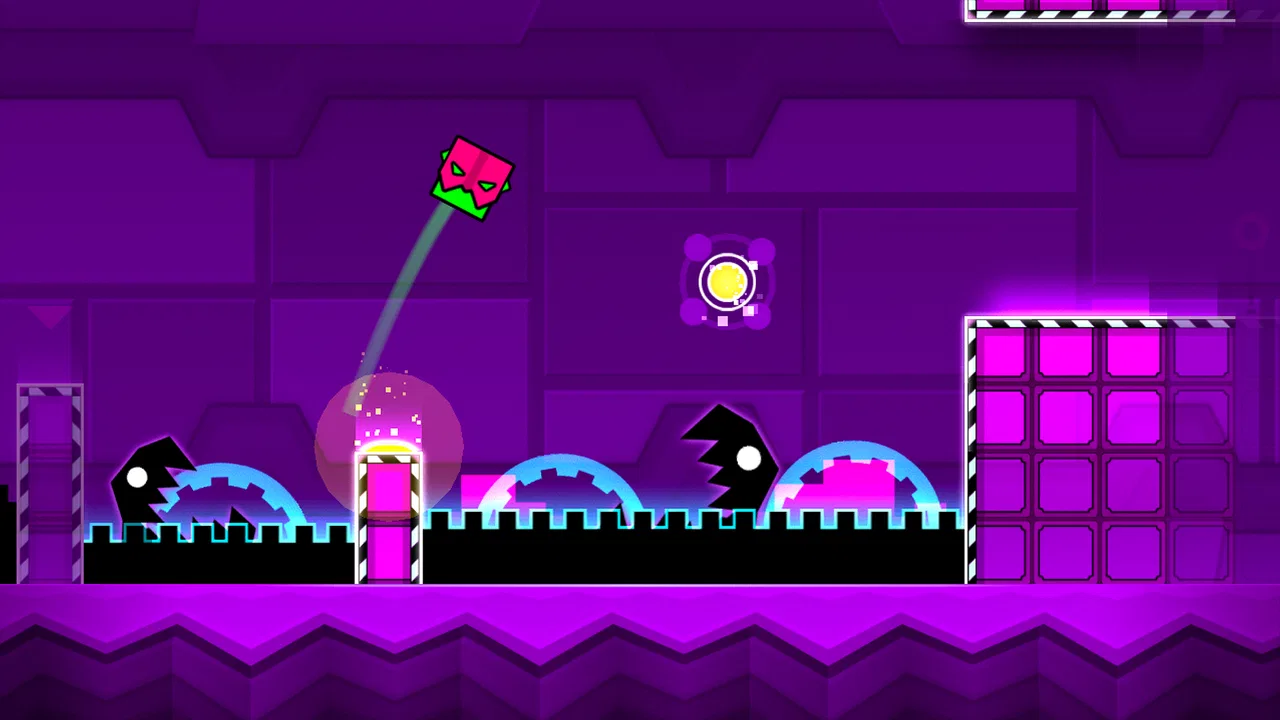
RobTop Games keeps the presentation focused on the action. The bright geometric shapes, sharp movement, and energetic soundtrack make the game readable without making it look plain. I found that visual clarity matters more than decoration in a title like this. When a jump fails, I can usually understand whether I reacted too early, too late, or failed to prepare for the next section.
The game is free, which makes trying it an easy decision for people who enjoy short arcade challenges. It is also rated for Everyone, so its presentation is accessible to a broad audience. That does not mean every player will enjoy it equally. The difficulty is the real filter here: younger or casual players may understand the controls immediately but still need patience to progress through demanding sections.
Its popularity is easy to understand. The game has passed 100 million installs and holds a 4.6 average from roughly two million ratings. Those figures do not guarantee that it will suit every player, but they reflect how well its compact formula has connected with people who like repeatable skill challenges.
Learning the course instead of fighting it
One useful change in mindset is to stop treating every attempt as a test of reflexes. When I first played, I reacted to each obstacle separately and often failed because I was already late for the next one. The better approach is to study a sequence as a small phrase: notice where the character leaves the ground, where a tap must be held or released, and where the following hazard appears. Once I viewed the level this way, progress became less mysterious.
I also found it helpful to use short practice goals. Rather than trying to complete an entire level immediately, I focused on reaching one difficult transition consistently. That turns a frustrating run into a manageable exercise. After repeating the section, I could return to the beginning with a better sense of its pacing. This is one of the game’s less obvious strengths: it rewards deliberate repetition, not just fast reactions.
Another practical tip is to play with a stable grip and a clear view of the screen. Because the control is so sensitive, a careless tap can ruin an otherwise good attempt. I prefer using one finger and keeping my hand relaxed, especially during sections where several inputs arrive close together. The game does not need a controller or a complicated setup, but a comfortable position makes a noticeable difference.
Headphones can also help, particularly when the surroundings are noisy. The music is not merely background decoration; it gives the level a pulse that can support visual timing. I would not rely on audio alone, since screen cues remain essential, but listening carefully can make repeated sections easier to memorize. This is especially useful when I am trying to distinguish a quick tap from a longer input.
Where the challenge becomes a drawback
The same precision that makes the game rewarding can make it tiring. A small timing error usually has a large consequence, and repeated failure can feel harsh when I am playing casually. I would not choose this as a relaxing game after a stressful day if I want something forgiving. It asks for attention, and it does not always provide a gentle path back into the action.
The restart loop is fast, which is good, but speed does not remove frustration. After several failed attempts at the same obstacle, I sometimes found myself tapping more aggressively instead of more accurately. That is exactly the wrong response. The game rewards calm timing, while its quick pace can encourage impatience. Players who dislike repeating a section many times may decide that the challenge is more annoying than entertaining.
There is also a difference between understanding the controls and feeling in control. The first lesson takes almost no time, but mastering the movement requires practice. A player looking for a casual arcade game with frequent rewards may prefer a title with upgrades, collectibles, or more forgiving checkpoints. Geometry Dash Meltdown is better suited to someone who enjoys improving a personal performance through repetition.
Screen size and touch response can affect the experience as well. On a smaller phone, the action remains playable, but the visual field may feel more crowded during fast sequences. If a device has inconsistent touch input, precise sections become even more difficult. I would not blame the game for every failed tap, but this is a title where hardware comfort matters more than it does in a slow puzzle game.
How it fits into everyday play
My favorite use case is a short session with a specific target. For example, if I have ten minutes before leaving home, I can play several attempts, identify one troublesome transition, and stop after making progress. The game works well in that setting because it starts quickly and does not require a long story or a complicated setup. I can return later and remember the basic goal immediately.
It is less suitable when I want a game to accompany conversation or television. The timing requires too much attention, and background distractions quickly turn into mistakes. I also would not recommend it as a first choice for someone who wants a narrative adventure, strategic planning, or relaxed exploration. Its pleasure comes from movement and precision, not from discovering a large world or managing a long-term character build.
Compared with a traditional endless runner, this game offers a more authored and memorization-based challenge. Compared with a music game, it demands more direct control because the player must navigate hazards rather than simply follow prompts. That middle ground is what makes it distinctive. It can appeal to people who enjoy rhythm games but want more physical interaction, as well as arcade fans who appreciate music-driven design.
Players should also know what kind of progress to expect. The satisfaction is mainly personal: reaching farther, surviving a difficult pattern, and eventually completing a section that once seemed impossible. If you need constant unlocks or visible rewards to stay motivated, the structure may feel limited. If you enjoy the feeling of converting mistakes into reliable skill, the same structure becomes the reason to keep playing.
Who should download it
I think Geometry Dash Meltdown is a strong choice for players who like fast restarts, precise tapping, and levels that can be learned through repetition. It is especially good for someone who wants an arcade game that fits into short sessions but still has enough difficulty to remain interesting over time. The free price removes much of the risk, so curious players can try the core experience and quickly decide whether the rhythm suits them.
I would be more cautious about recommending it to players who become frustrated by repeated failure, need generous checkpoints, or prefer games that can be played while multitasking. It is also not ideal for anyone seeking a calm experience. Even though the controls are simple, the concentration required during later attempts can be intense. A player who enjoys difficult platforming will probably understand the appeal faster than someone who expects effortless entertainment.
The current version is 2.2.147 and supports devices running Android 6.0 or later. That makes checking device compatibility worthwhile before installing, especially on an older phone or tablet. On a suitable device, the game’s straightforward input and compact format make it easy to pick up. The important question is not whether the controls are accessible; they are. The question is whether the player enjoys practicing the same challenge until the timing becomes natural.
RobTop Games has built a focused arcade experience rather than an all-purpose mobile game. That focus is a strength because almost every part of the design serves the movement and rhythm. It is also a limitation because there is little room for players who want variety outside that central loop. I appreciate that clarity, but I would not pretend the game offers something for every mood.
My final recommendation
After spending time with it, I see Geometry Dash Meltdown as a compact test of patience disguised as a simple tap game. Its strongest feature is the connection between music and movement: when I am in sync, each jump feels clean and deliberate, and when I miss, the reason is usually understandable. The game creates a satisfying sense of improvement without needing complicated systems.
Its main weakness is equally clear. The difficulty can turn a quick break into a string of tense retries, and players who dislike repetition may run out of patience before the game reveals its deeper appeal. I recommend approaching it with small goals, headphones if possible, and the expectation that progress will come from learning rather than luck.
For me, this is a worthwhile free arcade game when I want a focused challenge that starts immediately and rewards persistence. It is not the best alternative to a relaxed runner or a story-led platformer, but it stands out for players who want rhythm, precision, and fast attempts in one package. If you enjoy turning repeated mistakes into reliable timing, this is a game I would gladly recommend to a friend.
FAQs for Geometry Dash Meltdown
01What is Geometry Dash Meltdown and how does it differ from the original Geometry Dash?
Geometry Dash Meltdown is a rhythm-based platformer game developed by RobTop Games. It serves as a spin-off of the original Geometry Dash, featuring new levels, custom music, and unique challenges. While the core gameplay mechanics are similar, Meltdown offers exclusive levels with different themes and tracks, making it a fresh experience even for seasoned players of the original game.
02Is Geometry Dash Meltdown free to play, and are there any in-app purchases?
Yes, Geometry Dash Meltdown is free to download and play on both Android and iOS devices. However, like many free apps, it contains in-app purchases. These purchases primarily offer players the ability to remove ads and unlock additional cosmetic items. While purchasing is optional, it can enhance the gameplay experience by eliminating interruptions.
03What are the system requirements to run Geometry Dash Meltdown on mobile devices?
Geometry Dash Meltdown requires a device running Android 4.0 or higher, or iOS 8.0 or later. It is compatible with most smartphones and tablets, but for the best experience, a device with a stable internet connection and decent processing power is recommended to handle the game's fast-paced, rhythm-based challenges without lag.
04Can I play Geometry Dash Meltdown offline, or do I need an internet connection?
Geometry Dash Meltdown can be played offline, which makes it a great option for gaming on the go without needing a constant internet connection. However, an internet connection is required for certain features such as downloading updates, accessing leaderboards, and making in-app purchases. Playing offline will not affect the core gameplay experience.
05How challenging is Geometry Dash Meltdown for new players?
Geometry Dash Meltdown can be quite challenging for new players due to its fast-paced gameplay and precise timing requirements. However, the game is designed to progressively increase in difficulty, allowing players to develop their skills over time. Patience and practice are key, and the game offers a rewarding experience as players improve and conquer each level.
Pros
- Engaging and challenging gameplay.
- Vibrant graphics and catchy soundtrack.
- Simple
- one-touch controls.
- Frequent updates with new levels.
- Offline play available.
Cons
- Limited levels compared to the full version.
- Can be frustratingly difficult.
- Ads can interrupt gameplay.
- No custom level creation.
- Requires precise timing and focus.

Geometry Dash Meltdown
Gallery